

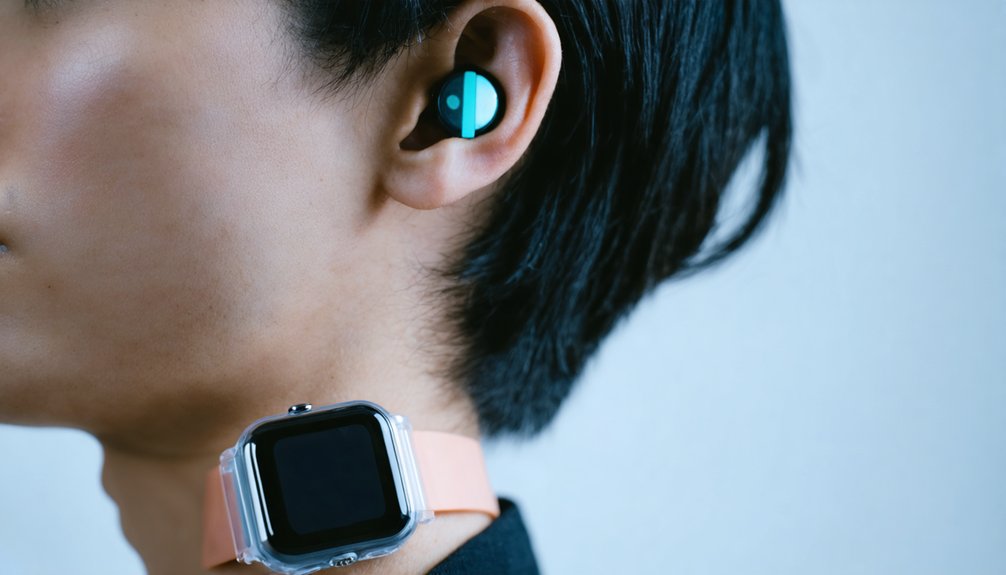
The future of wearable technology centers on AI-driven, edge-enabled devices delivering real-time health, payment, and industrial monitoring. Market size estimates vary widely (≈USD 70–180B in 2024; projected USD 150–330B by 2030) with CAGRs ~12–19% and faster growth in Asia Pacific. Advances in 3D chip stacking, SiP, flexible sensors, and textile integration enable continuous biosensing and on-device inference. Enterprise and rugged use cases expand rapidly amid regulatory and power constraints, and the next sections outline key enablers and risks.
Key Takeaways
- Wearables will shift from passive trackers to autonomous, on-device AI health and coaching platforms with real-time personalized recommendations.
- Advances in semiconductor packaging and 5G/edge hardware will enable low-latency, energy-efficient local inference and richer sensors.
- Textile-integrated sensors and flexible electronics will deliver continuous, clinical‑grade biomonitoring for glucose, lactate, ECG, and respiratory metrics.
- Enterprise and industrial adoption will rise for safety, productivity, AR-assisted workflows, and remote diagnostics with rugged, secure wearables.
- Energy‑harvesting fabrics, improved batteries, and GaN-efficient components will extend uptime toward days or energy‑autonomous operation.
Market Size, Growth Trajectories, and Forecasts
How large is the wearable technology market and how fast is it growing? The market is estimated between USD 70.30B and USD 179.8B in 2024, with 2025 forecasts of USD 84.53B–88.97B and long‑range projections from USD 152.82B (2029) to USD 995.2B (2034) across sources.
CAGR estimates vary: 12.0%–18.9% broadly, with wearable AI at ~27.6% (2025–2035).
Drivers include health monitoring, AI analytics, payments, enterprise adoption, and miniaturized sensors.
Wristwear dominance and ~400M units shipped in 2024 anchor volume assumptions.
Regional leadership (North America ~39%) and corporate incumbents shape demand.
Market resilience depends on optimized supply chains and active secondary markets to extend device lifecycle and foster community adoption. A recent industry report also notes that the global market was valued at USD 78.39 billion in 2024, with a projected CAGR of 13.5% for 2025–2033. Increasing interest in personalized health and wellness is expected to further propel adoption of wearables driven by innovations in AI and 5G. Furthermore, analysts project North America will hold approximately 30% share by 2035.
Breakthroughs in Semiconductor and Chip Packaging Technologies
In recent years, breakthroughs in semiconductor and chip packaging—including 3D chip stacking, fan-out wafer-level packaging (FOWLP), and system‑in‑package (SiP) approaches—have driven dramatic size, performance, and thermal gains for wearables.
The industry reports 3D stacking increases chip density by up to 50%, lowering latency and power. FOWLP and wafer-level methods shrink component size 30–40% and improve thermal paths. SiP modules reduce device footprint by 35% by integrating processors, memory, and RF.
Heterogeneous integration and flexible substrates enable curved, conformable designs while maintaining high transistor densities below 5 nm. Smartwatches drive wrist-worn wearable growth and GaN materials deliver ~40% better power efficiency and superior thermal performance in compact packages.
Advanced packaging also streamlines supply chains, enabling inclusive device design and broader community adoption. Recent market analysis indicates a growing industry valued at approximately $20 billion in 2025, supporting continued investment and innovation. The sector is also being driven by artificial intelligence workloads that require ever-faster, more efficient edge processing.
The Rise of Wearable AI and Edge Computing
Fueled by advances in on‑device AI and edge computing, wearable devices are shifting from passive sensors to autonomous health platforms that perform real‑time inference, conversational assistance, and personalized recommendations at the point of care. Data shows generative AI enables health scoring and on device personalization, while smartwatches evolve into holistic health coaches led by Apple, Samsung, and Garmin. Hospitals deploy edge-powered wearables for instant medical decision-making and remote diagnostics, reducing critical response times. Gartner predicts 75% of enterprise processing at the edge by 2025, driving sub-millisecond latency and lower cloud costs. Security follows with zero-trust models, continuous verification, and encryption to address 75 billion connected devices. Emphasis on edge ethics guarantees inclusive, accountable deployment as communities adopt these transformative systems. The growing industry shift away from legacy virtualization vendors has accelerated interest in edge-native solutions, prompting many organizations to plan transitions to containerized, edge-optimized architectures that prioritize flexibility and cost control. Advances in 5G and dedicated edge hardware further enable low-latency processing for real-time wearable applications. Recent industry roadmaps indicate a rapid rise in edge deployments leveraging agentic AI.
Advances in Sensors, Flexible Electronics, and Textile Integration
As wearables move from cloud-dependent assistants to edge-native health platforms, sensor, flexible-electronics, and textile advances provide the hardware foundation for reliable, continuous biomonitoring.
Multi-modality platforms combine electrochemical, optical, and mechanical sensors for simultaneous biomarker tracking, enabling non invasive biosensing of glucose, lactate, cortisol with clinical-grade 9% MARD performance.
Textile-embedded strain gauges and knitted electrodes deliver 94% spirometry correlation and <1kΩ ECG impedance during motion.
Ultrathin polyimide, silver nanowire electrodes, graphene sensors, and self-healing polymers enable durable, low-profile circuits and stretchable displays integration.
Energy-autonomous textiles use TENGs, thermoelectrics, flexible batteries, and wireless coils for sustained operation.
Photoluminescent yarns and capacitive fabrics add high-rate data links and gesture control.
These advances create an inclusive ecosystem for trusted, continuous health monitoring.
Recent reviews have highlighted rapid progress in wearable sensor design that bridges materials, electronics, and machine learning for real-time, actionable insights.
Regional Opportunities and Market Dynamics
Across regions, wearable technology market dynamics are defined by distinct growth drivers and adoption patterns: North America leads with a 35.6% share in 2024 and a projected sustained dominance (~30% by 2035) supported by a mature digital-health ecosystem and major platform providers; Asia Pacific represents the fastest-growing segment with a projected 20.0% CAGR through 2030 driven by rising purchasing power, manufacturing shifts, and China’s large-volume competitiveness; Europe’s demand centers on aging-population use cases—remote monitoring and fall detection—underpinned by government digital-health initiatives; the Middle East shows rapid uptake in payments-enabled wearables while South America’s growth is enabled by rising smartphone penetration (projected 92% by 2030).
Collectively, global market estimates range from USD ~70–86B in 2024 to forecasts between USD 153B and USD 331B by 2030–2035, reflecting divergent regional contributions and trajectories.
Regional strategies emphasize regulatory incentives to accelerate adoption, optimized cross border logistics to lower production and distribution costs, and targeted investment in local ecosystems.
Stakeholders prioritize data-driven partnerships, supply-chain resilience, and inclusive access to guarantee regions share in wearable technology growth.
Consumer Drivers: Health, Payments, and Fashion Convergence
Through converging health tracking, contactless payments, and fashion-tech, consumer demand is reshaping wearable product strategies and monetization models. Market data show rapid uptake as biosensors (sweat analysis, hydration, core temperature) and optical pulse oximetry standardize health metrics; FDA-cleared heart-rate devices and AI-driven coaching shift offerings toward holistic wellness ecosystems.
Payment integration via smart rings, LTE-enabled wearables, and sensor-embedded apparel creates secure, smartphone-independent transactions, driving premium differentiation. Style personalization and sustainable materials boost willingness to pay, aided by fashion-tech collaborations and a USD 84.2B market with strong European sustainability CAGR.
Designers and engineers balance utility with health privacy, deploying on-device processing and encrypted payments. This convergence fosters community among consumers seeking integrated, secure, and stylish health-focused wearables.
Enterprise and Industrial Applications of Rugged Wearables
In industrial settings where durability and uptime are paramount, rugged wearables are emerging as mission-critical tools, with the global B2B industrial wearables market at USD 12.86 billion in 2024 and projected to reach USD 114.5 billion by 2033 (27.5% CAGR).
Adoption is data-driven: rugged wearable computers hit USD 1.67 billion in 2024 and hardware held 56.5% revenue share in 2023.
Enterprise use cases include production monitoring, AR-assisted troubleshooting, supply chain tracking, and worker onboarding workflows that accelerate competency.
Biometric and environmental sensors enable fatigue detection, safety monitoring, and 12-hour shift reliability.
Manufacturing, IT & Telecom, healthcare, and retail together account for the majority of deployments.
Declining costs and digital transformation momentum foster cohesive teams centered on operational efficiency and shared safety outcomes.
Key Challenges, Regulatory Landscape, and Adoption Barriers
Following rapid industrial adoption of rugged wearables for production monitoring, AR troubleshooting, and safety, a cluster of technical, regulatory, and market barriers now constrains broader deployment.
Technical constraints—battery life (8% abandonment), limited functionality (21%), component miniaturization, and supply chain vulnerabilities—reduce reliability and prolong time-to-market.
Data quality issues (9% abandonment) and sensor limits hinder clinical-grade features; blood pressure and glucose monitoring face stalled development.
Regulatory uncertainty and increasing compliance obligations slow launches and force region-specific redesigns.
Market adoption barriers include smartphone dependency (14%), poor integration (9%), lack of connectivity (9%), and unclear value propositions driving cost sensitivity and obsolescence concerns.
Strategic focus on power management, validation, and harmonized regulation is essential to lower adoption barriers and build community trust.
References
- https://straitsresearch.com/report/wearable-technology-market
- https://www.marketsandmarkets.com/Market-Reports/wearable-electronics-market-983.html
- https://www.researchnester.com/reports/wearable-technology-market/4840
- https://www.prnewswire.com/news-releases/wearable-technology-market-to-grow-by-usd-99-4-billion-from-2025-2029–boosted-by-the-popularity-of-wearable-devices-as-a-payment-method-ais-impact-on-market-trends—technavio-302362894.html
- https://www.factmr.com/report/wearable-ai-market
- https://www.wissenresearch.com/wearable-technology-market/
- https://www.fortunebusinessinsights.com/wearable-technology-market-106000
- https://www.idc.com/promo/wearablevendor/
- https://www.towardshealthcare.com/insights/us-smart-wearables-market-sizing
- https://www.gminsights.com/industry-analysis/wearables-market